

When it comes to life in the Earth’s oceans, the smallest players often have the biggest roles. Trace elements, aptly named for their minute concentrations in seawater, can control the distribution of life in the surface ocean and help regulate the planet’s climate.
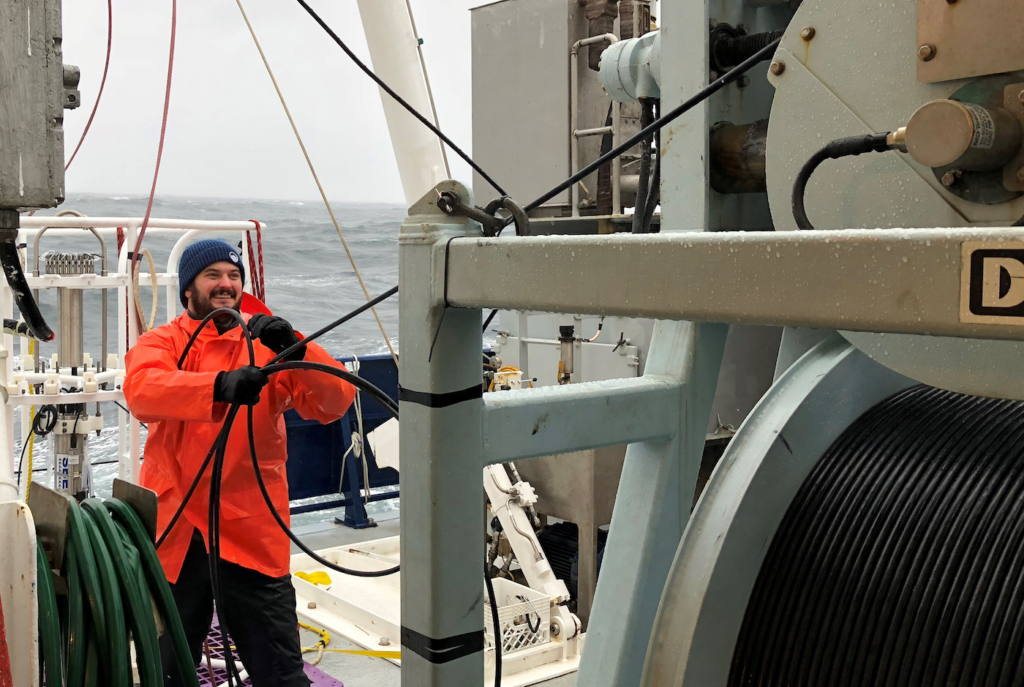
University of Georgia Skidaway Institute of Oceanography (SkIO) faculty member Clifton Buck’s research on trace elements has taken him and his lab members all over the world, from the coast of Hawaii to the frigid waters of the North and South Poles. They travel to some of the ocean’s most remote locations, collecting samples from the water and atmosphere to analyze trace element concentrations.
Phytoplankton are microscopic plant-like organisms that form the base of the ocean food web and, through photosynthesis, absorb carbon from the surrounding waters, which in turn pulls carbon dioxide from the atmosphere. In addition to sunlight and macronutrients like nitrate and silicate, phytoplankton require trace elements such as iron, zinc, manganese and copper for proper metabolic function. The elements often enter the ocean through runoff from coastal waterways or by being carried by wind in dust clouds originating from distant arid regions such as the Sahara Desert.
“You can think of it like a farmer tending a field or even your lawn,” said Buck, a professor in the Department of Marine Sciences at UGA’s Franklin College of Arts and Sciences. “Like plants, phytoplankton will grow until they exhaust the nutrients available to them. There must be an external source of nutrients to support, or fertilize, them. Depending on what part of the ocean you are in, the source or sources can vary. However, in most of the open ocean, far from continents, the source is most often from above.”
GEOTRACES
Buck has a longstanding collaboration with the international GEOTRACES program, which includes scientists from 35 countries. The program aims to better understand how trace elements move through the ocean and influence marine chemical cycles. His participation has been solely funded by the support of the National Science Foundation.
Dozens of GEOTRACES cruises have taken place around the world, some lasting as long as three months. Members of the Buck Lab have participated in five cruises, including expeditions to the western Arctic Ocean, the west coast of South America, the central Pacific Ocean, and the northern coast of Antarctica.
A 2018 paper that Buck co-authored, published in the journal Chemical Geology, used data from a 2015 GEOTRACES cruise to find that the Arctic Ocean showed low mineral dust concentrations, confirming it as a remote, low-dust environment. The region is undergoing significant changes in climate, and the amount of summertime sea ice has significantly declined. That opens the door for the Arctic Ocean to receive more direct deposition of material from the atmosphere than in years past, making it particularly interesting to scientists.
Another paper, led by Buck and published in 2019 in Chemical Geology, analyzed iron deposition in the eastern Pacific off the Peruvian coast using data from a separate GEOTRACES cruise in 2013. The study found that offshore waters in the region have lower and more uniform iron concentrations than near the coast. While coastal waters receive iron through multiple channels, offshore waters rely more heavily on atmospheric deposition.
In 2018, Buck also participated in a GEOTRACES cruise from Alaska to Tahiti during a low-dust season, coinciding with the annual minimum in dust transport from Asia. The team measured trace element concentrations on airborne particles and published their findings in 2022 in Global Biogeochemical Cycles. Their work confirmed low concentrations of trace chemicals in the region during the low-dust season.
Most recently, in November 2022, Michael Sheridan, a former graduate student in Buck’s lab, went with fellow Skidaway graduate student Mariah Ricci, a recent graduate from fellow Skidaway faculty member Dan Ohnemus’ lab, on a GEOTRACES cruise that traveled below the Antarctic Circle. Sheridan collected atmospheric samples for 56 days from the South Pacific Ocean to the Southern Ocean and finally to Chile.
In recognition of his role as the primary U.S. expert in the GEOTRACES program, Buck was honored to lead the writing of a retrospective commentary on that program published in “Oceanography,” the flagship magazine of The Oceanography Society, in early 2024. In 2026, Buck delivered an online seminar sponsored by the GEOTRACES Early-Career Scientist Committee wherein he shared a historical perspective on the study of atmospheric deposition and outlined some of the key unknowns that continue to drive research.
Hawaii Aerosol Time Series
Since 2020, Buck has also been involved in the Hawaii Aerosol Time Series (HATS) project. Developed in collaboration with Ohnemus, an associate professor in the UGA Department of Marine Sciences, and former postdoctoral researcher Chris Marsay (now at the University of Delaware), HATS has revealed how atmospheric dust is deposited into a region of the Pacific Ocean northeast of Hawaii and how it influences chemical and biological processes. HATS was funded by a grant from the National Science Foundation.
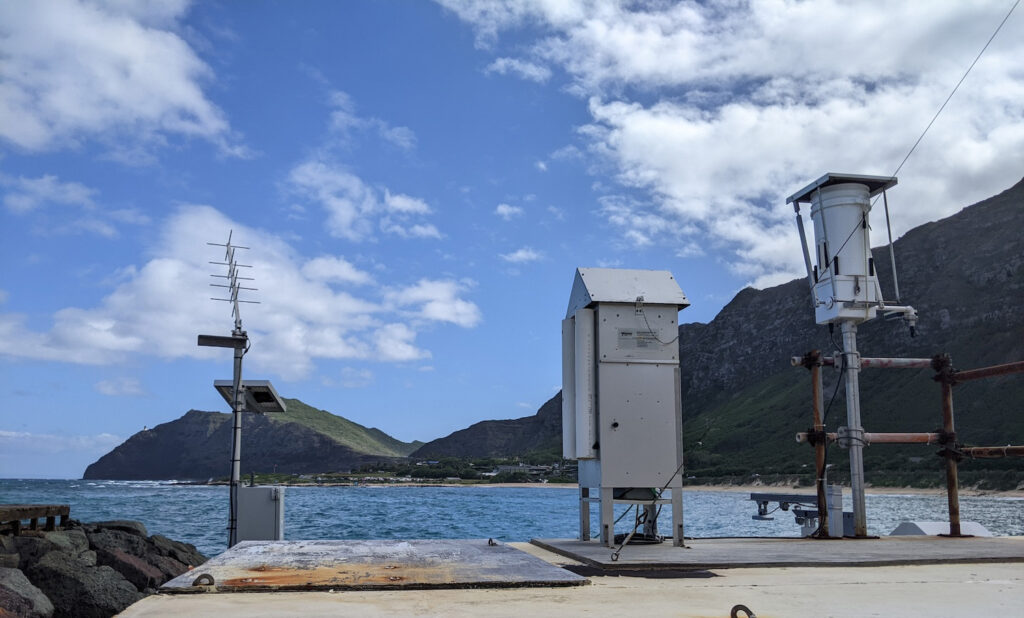
“HATS grew from an idea I had when I was a postdoc in California,” said Buck. “It took the combined expertise of our team to make it a reality. There are few places in the world that provide the combination of infrastructure and location that make for a quality observation site. Oahu happens to be one of those places. This project required two years of atmospheric sampling and six research cruises and would not have been possible without the support of the University of Hawaii’s Dr. Nicholas Hawco and Dr. Eleanor Bates.”
The project includes direct measurements of both atmospheric dust aerosols and particles within the water column at the long-running Hawaii Ocean Time-series Station ALOHA, located about 100 kilometers north of Oahu, Hawaii. The atmospheric work was a key piece in the doctoral work of Charlotte Kollman, who has since graduated and is now continuing at Skidaway as a postdoctoral researcher.
Previous observations and modeling show that dust near Ocean Station ALOHA is mostly transported from Central and Eastern Asia. Forthcoming comprehensive field results from the project will include details on how much dust is reaching the region, what that dust is made out of, how much of it falls into the ocean, seasonal fluxes, and what happens to the dust once it enters the ocean.
“A lot of existing work has focused on the importance of the Asian dust plume in the spring, which transports a large volume of material to the North Pacific Subtropical Gyre (NPSG),” said Kollman. “Our study, which is a culmination of two years of sampling, highlights the additional importance of aerosol deposition in the late summer and fall and points to the influence of more local sources beyond the Asian desert regions.”

“By pairing both water column and aerosol measurements of the Beryllium-7 radioisotope, which is only produced in the atmosphere, with our aerosol measurements of a suite of trace metals, we’re able to estimate how much atmospheric material is being deposited to the surface on both seasonal and annual cycles,” she added. “Understanding how sources, flux, and composition of aerosols transported to the NPSG varies over time gives us insight into how the local biological demands of the system are being supported, which our collaborators can then use to help us paint a better picture of what’s happening in the surface ocean on those same cycles.”
Looking forward
The North Atlantic Ocean is the site of the most significant atmospheric deposition of continental material in the world. Prevailing winds carry dust from western North Africa over the ocean all the way to the Americas. As a result, this is one of the most studied regions, and the basin includes several longtime sampling sites. One such site in Bermuda, the Tudor Hill Marine-Atmospheric Observatory, has been in near-continuous operation since 1988. In a project led by Marsay of University of Delaware, Buck and his colleagues are leveraging that asset to conduct a comprehensive exploration of the role that particle size plays in determining the amount of iron and other trace elements that are introduced to the ocean from the atmosphere.
“Bermuda is a perfect site to study the Saharan Dust Plume because the island lies directly in the path of dust transport,” said Buck. “We have been collecting aerosols there for about two years with special collectors which are able to partition the material based on its size. With those samples, we are able to determine how element solubility is affected by the size of the particle.”
Other goals for the project include constraining the supply rate for atmospherically derived trace elements and determining the relative importance of potential sources using chemical tools like stable isotopes.
“This project is exciting because it brings together many of the most advanced tools we have to explore atmospheric deposition,” said Buck.
Kollman will be in charge of the sample processing and analyses.
“This is a natural next step for her, and I have the utmost confidence that she will make the project a success,” Buck added.
About SkIO
The UGA Skidaway Institute of Oceanography (SkIO) is a multidisciplinary research and education institution located on Skidaway Island near Savannah, Georgia. The Institute was founded in the late 1960s with a mission to conduct research in all fields of oceanography. In 2013, SkIO was merged with the University of Georgia. The campus serves as a gateway to coastal and marine environments for programs throughout the University System. The Institute’s primary goals are to further the understanding of marine and environmental processes, conduct leading-edge research on coastal and marine systems, and train tomorrow’s scientists. For more information, visit www.skio.uga.edu.