

The Doliolideer gang was back at it this month completing the fifth and final science cruise associated with the NSF supported DolLAYER project. If this is the first time you are reading about the DolLAYER project, in a nutshell, the focus of the project is to advance our understanding of how oceanographic processes that structure the water column result in the structuring of microbial and zooplankton communities and consequently the pelagic food web on subtropical continental shelf systems. A specific focus has been on small gelatinous zooplankton including doliolids and salps. You can read more about DolLAYER here.
Getting ready for the trip was as hectic and complicated (as usual) with equipment needing to be organized and checked, supplies ordered, etc. But with a now experienced core team, we were able to get organized in record time. Of course, with as many moving parts as are involved in a research cruise, nothing ever goes quite as planned. This time was no exception. I won’t go into the gory details, but we ended up leaving a day late, down a member of the science team, and a not quite functioning lab van that we use to provide necessary additional laboratory space on the Research Vessel (RV) Savannah.
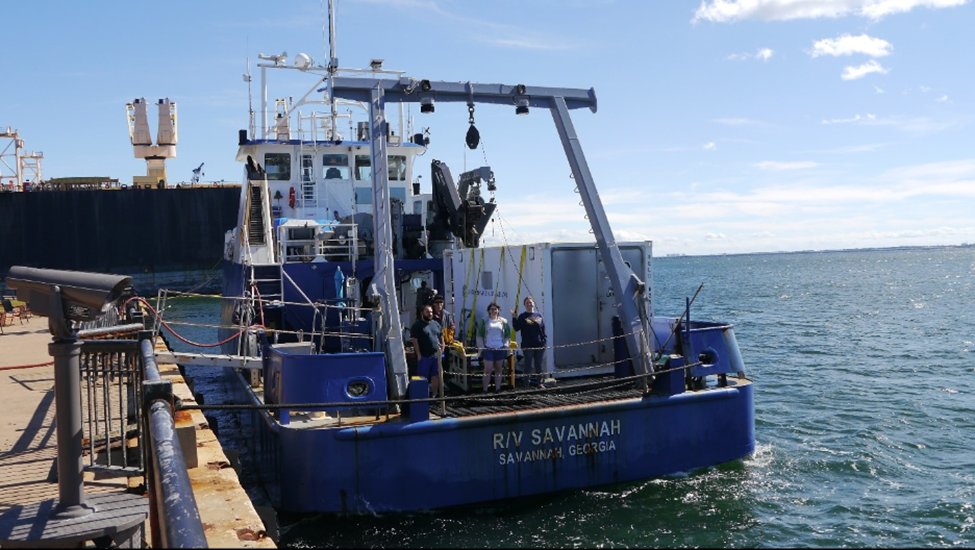
Shared-use lab van from UNOLS (University-National Oceanographic Laboratory System) on the RV Savannah. Photo taken in November 2025 at port in Pensacola, Florida on DolLAYER cruise #10. Photo by M. Frischer
The science team was even more diverse than usual. In addition to the core research groups including members of the Greer, Frischer, Brandes (UGA-SkIO), and Treible (Savannah State University) labs, Sean Anderson from the Cohen Lab (UGA-SkIO) joined us again. We were also joined by two graduate students, Julia and Jordan, from Nick Peng’s group at Ohio State University (formally at the University of South Carolina). They were focused on studying marine fungi and whether there was an association with pelagic tunicates (doliolids and salps). These animals form their tunics (structural body parts) from an ancient version of cellulose. On land, fungi are primarily involved in the digestion of structural carbohydrates such as cellulose, but those types of molecules are rare in marine systems. Nick and his group are interested in finding out whether fungi are on the job in the ocean. We were also joined by an enthusiastic and competent undergraduate student, Katelyn from Nova Southeastern University. In all, we were 11 scientists.
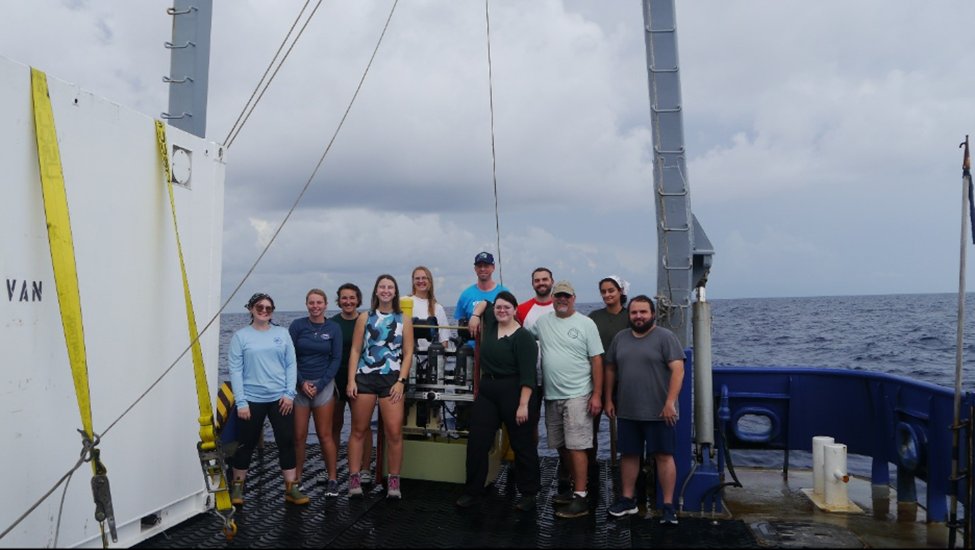
Science crew on the DolLAYER 11 expedition. Photo by M. Hudgins.
It takes a lot to get organized, but when it is finally done and we get out to sea with all the right people, equipment, and supplies, it is worth it. All that is necessary is for Mother Nature to cooperate.
From my perspective, what we really needed from Mother Nature was for her to provide us with a bloom of doliolids or salps. We had encountered a doliolid bloom last summer in the Gulf of Mexico but had not the previous summer in the South Atlantic Bight (SAB). The hope was that this final summer in the SAB that we would find one. Spoiler alert, on the second to last day of the cruise, we found one!
Finally offshore, we began visiting the stations we had established that included sites from the middle shelf regions offshore from Savannah, GA to St. Augustine, FL spaced relatively close together. The large-scale features in this area were quite similar to each other with clear evidence of water column temperature stratification, upwelling of cool nutrient-rich deep water, and subsurface productivity but, the biology and biological communities and each station were remarkably different and diverse. “Why, how, and so what?” are the big picture questions that our research is focused on answering. The current state of knowledge provides us with a fundamental and mechanistic understanding of how ocean physics can structure shelf systems on a broad scale but, at biologically relevant fine scales, our understanding is incomplete. For example, why at the station off Savannah, the subsurface plankton community below the thermocline, was dominated by a bloom of radiolarians (Collodaria), while just a few miles away off the coast of Brunswick, GA, Collodaria was gone, but there was a 10-meter mid-water layer of the diatom Rhizosolenia sp.? And what is the effect of these differences on the food web? These are the types of questions that the data we collect will help us answer.
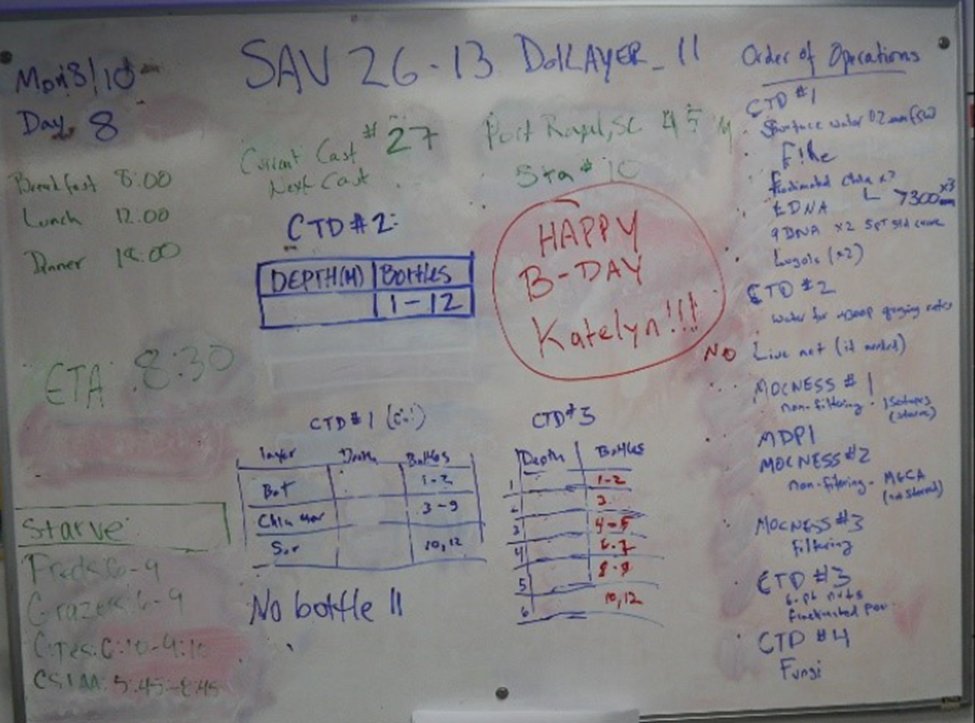
White board we used to communicate and keep track of daily operations. Katelyn had a birthday during the cruise. Photo by M. Frischer.
After the slow start we quickly fell into a rhythm. The days were organized by our “Order of Operations” plan that structured how we sampled at each station most efficiently. Sampling at a station generally required 5-6 hours to complete so on days when two stations were close to each other, we were able to complete two stations and, if not, only one and we used the night to transit to the more distant location. Of course, sampling is always dependent on weather conditions, and if it gets rough, we slow down. If it gets too rough, we have to stop. That happened midway through the cruise when the winds shifted from the south/southwest to the east. One day it was too rough for us to work, so we headed inshore, anchored, and waited it out. Luckily for us it only lasted a day.
Afterwards, the biological communities had been altered, and we had the opportunity to resample many of the stations that we had sampled in the prior week. This allowed us to sample more diversity and likely will provide a lot of clues about how biological systems respond and adapt to rapid environmental changes. What we are learning will be helpful in advancing our understanding of continental shelf communities in the face of an increasingly dynamic environment.
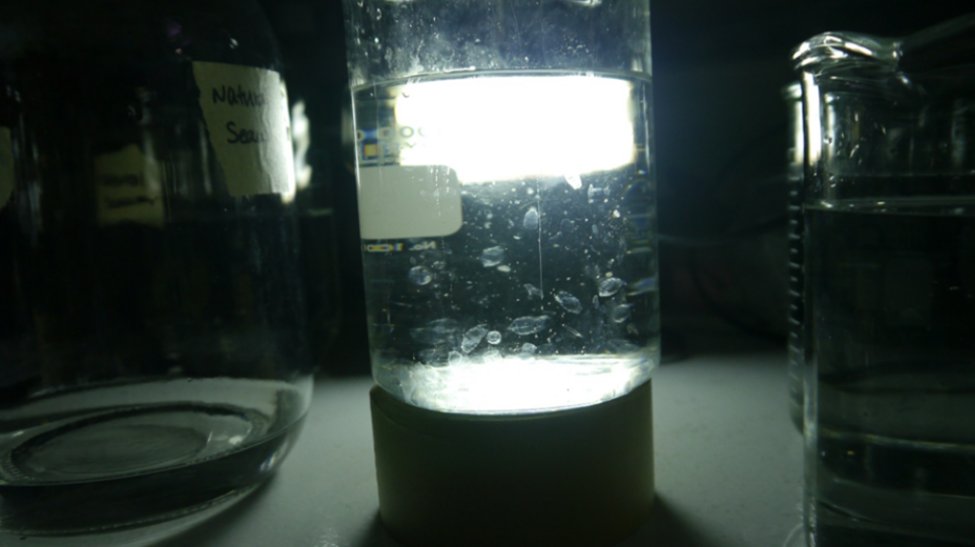
Doliolids in a jar, captured from a bloom on August 10, 2026, off the coast of Port Royal, SC. Photo by M. Frischer.
With just two days left in the expedition and despite the delays, we had completed all our planned stations, but we still hadn’t found that doliolid bloom that we had hoped for. We decided to move a little further north into South Carolina waters and there we were rewarded with the cherry on top of the project, a bloom of doliolids.
With all goals achieved, we headed back to port. For the next several years we will be processing and studying all the samples and data that we collected during the DolLAYER project, turning all that material into new knowledge and training the next generation of oceanographers to continue to explore and learn. Please stay tuned.
-Marc Frischer