

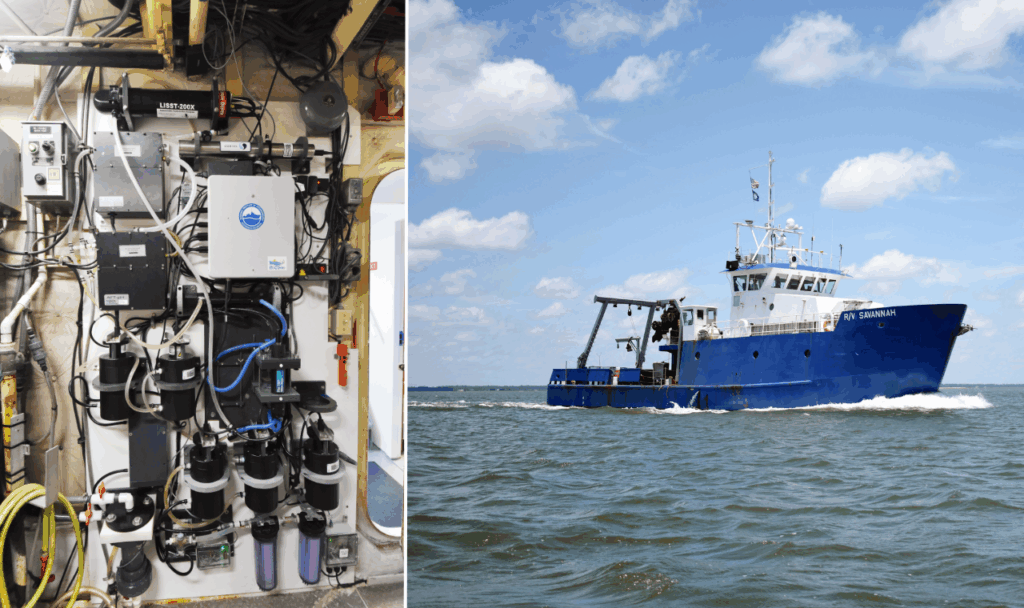
This spring, the Research Vessel Savannah was outfitted with a new flow-through system featuring more than a dozen instruments that continuously measure key biogeochemical parameters on the ocean’s surface as the ship travels. A corresponding online platform streams the live data to scientists, students and technicians both aboard the ship and on shore.
“The system effectively transforms the Savannah into a continuous sampling platform,” explained Sara Rivero-Calle, an assistant professor at the UGA Skidaway Institute of Oceanography (SkIO), who received a grant from the National Science Foundation (NSF) for the installation of the new system. “This includes the most comprehensive and state-of-the-art set of oceanographic instruments and sensors that you can have on a flow-through system. It has taken us several years to piece it together. It was a much bigger effort than we thought, but it is now ready for everyone’s benefit.”
In addition to temperature, salinity, chlorophyll and colored dissolved organic matter, the new system’s instruments actively measure turbidity, dissolved gases, nitrates, pH, CO2 concentration, light scattering, particle size distribution and more.
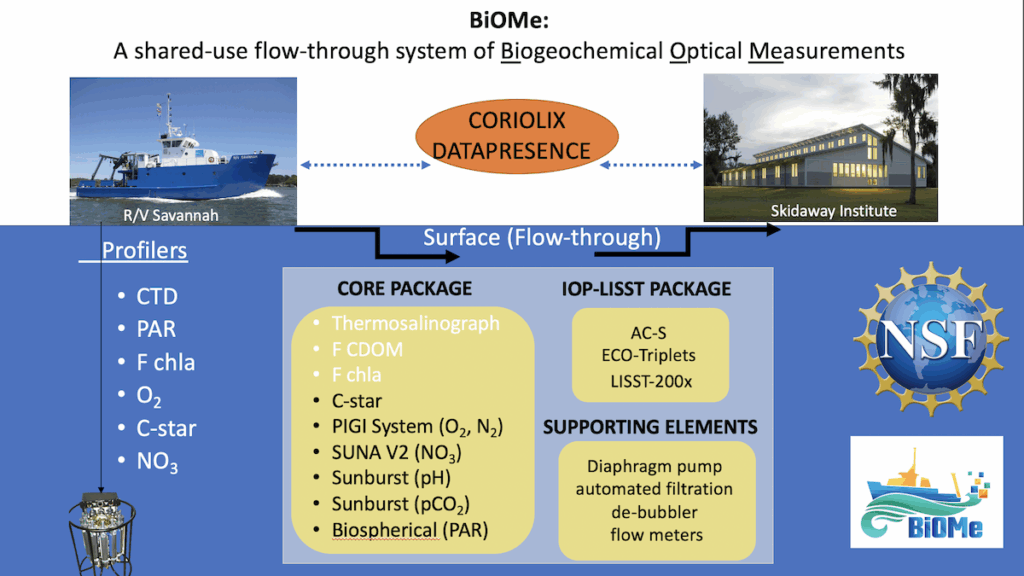
The new system provides high-quality oceanographic data in real time to both researchers on the ship and beyond. The R/V Savannah averages 144 days per year at sea and has operated as far away as Long Island, NY, and the coast of South America.
“The other advantage is that we can bring it into the classrooms,” said Rivero-Calle. “The R/V Savannah has limited space in terms of how many people can be on it. But I could be holding a class on Skidaway Island, and through the software, called CORIOLIX, we can see exactly what they’re seeing on the ship. I can bring that sea-going experience to the students.”
The new instruments are part of the NSF’s shared-use program, expanding access to cutting-edge technology and high-resolution data on an unprecedented scale. The project, called BiOME, will complement and enhance ongoing and future projects in the Southeastern United States and beyond, Rivero-Calle explained.
The data presence system CORIOLIX was first developed by scientists at Oregon State University for implementation on the National Science Foundation’s three new Regional Class Research Vessels. The R/V Savannah is the most-recent University-National Oceanographic Laboratory System (UNOLS) vessel to use CORIOLIX and the only coastal class vessel with it.
About SkIO
The UGA Skidaway Institute of Oceanography (SkIO) is a multidisciplinary research and education institution located on Skidaway Island near Savannah, Georgia. The Institute was founded in 1967 with a mission to conduct research in all fields of oceanography. In 2013, SkIO was merged with the University of Georgia. The campus serves as a gateway to coastal and marine environments for programs throughout the University System. The Institute’s primary goals are to further the understanding of marine and environmental processes, conduct leading-edge research on coastal and marine systems, and train tomorrow’s scientists. For more information, visit www.skio.uga.edu.
2 comments on “R/V Savannah outfitted with real-time ocean sampling flow-through system”
Comments are closed.